

Gary Stevenson is a phenomenon in the UK. This unique individual grew up with one advanced talent and with drive: his gift was mathematics and he wanted desperately to get out of poverty, to become a millionaire. Gary studied mathematics and economics in the London School of Economics (LSE) an institution created by rich Fabians in 1895 basing the social sciences curriculum on the Haute École Français Sciences Po model. The society itself was made up of mainly British socialists including the Irish socialist writer George Bernard Shaw. After graduating from LSE Stevenson worked for a few years in the high stress job of interest rates trader in London and Tokyo. As a financier who has made millions, even being CitiBank’s best trader in one of those years. Gary’s tag line is “Tax Wealth not Work”.
He is nothing you would expect from an English multimillionaire, especially a financial trader. Gary grew up in working class inner London Ilford borough. His parents were working class, his dad worked nearly 40 years for the Royal Mail. They were poor but dignified members of the working class. From their wages they bought and owned their small house when his dad was 26, and his mum was 23. The limit that the banks would loan for purchasing a house was 2.5 times their salary, but even a postal worker could buy a house in London for that.
To those, like Gary, who understand the economic motors of asset inflation (like housing in London) and know how to compare that with working class income growth, it is evident why this is so difficult to do right now. Put another way; can you buy a house in Ilford for £80,000 pounds. But for most people it can be difficult to make this connection. It is literally almost impossible for someone from the working class to own London property. This is Gary’s point and he explains why reversing this is key to retaining democracy. Destroying the extreme wealth gap that is undermining democracy not just in the UK but worldwide is his personal project and the means to do this is wealth taxation.
The wealth gap is not about income but about assets, about ownership. This is something that is not new but something that has returned to feudal levels in two generations in the UK, basically during Gary’s lifetime.
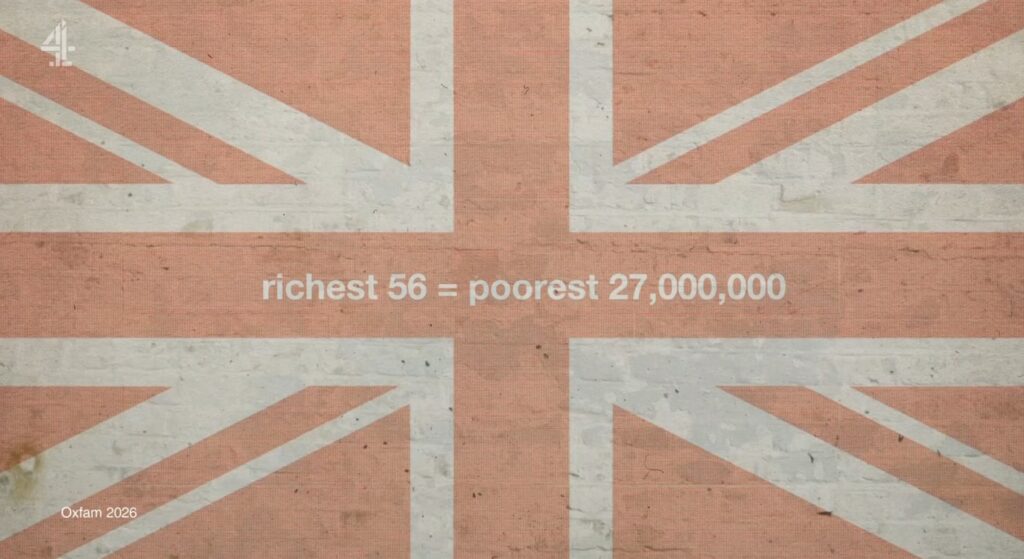
The wealth gap between the rich and the poor which has returned to previous feudal extremes gives a very small number of people so much money that they can literally set the agenda for the whole country. “The richest 56 people in the UK now own as much 27 million of the rest of us.” says Gary in his documentary. Gary cites investors in UK property, bonds and shares. These investors that literally own the country and its private sector also own the public sector too (literally) because they buy the bonds that keep the public sector working. Instead of paying taxes they are paid interest on these investments from other people’s taxes.
Gary explains the in terms of a Great privatisation. After decades of privatising state assets (Tunnels, Electricity, Gas, Water, Streets, Libraries etc…), assets that were previously used by the UK to provide services to people (like the Chunnel to France for example that made train travel to the continent possible and improved tourism). The concentration of ownership of the UK State –holders of its approximately £1 Trillion in debt– has meant that the rich are concentrating their ownership of the state. They can manipulate government policy by threatening to sell their bonds if they don’t like state policy. The state owes the bondholders and often also needs to help poorer people pay services (for pensioners or the poor for example) the use of UK natural monopoly assets such as electricity from the grid or train systems. Now that these are privatised the subsidy payment goes to the private sector. The bonds were created too to fund bank lending and to keep taxes down (under both conservative and labour governments). Rich people convinced these governments to tax them less and only their incomes (not their wealth). Hence the wealth gap exploded.
Thus the state has gone into debt because it no longer owns the assets it needs to provide the public services to the people who elect them. What this means practically is that, roughly speaking, in two generations the UK government who are supposedly the representatives of the British people who elected and to work to serve their interests of the poor too, has gone from owning nearly 100% of the assets it needs to provide services (canals, streets, electricity, water and gas pipelines and electricity grids etc…) to owning almost nothing and owing about a year’s worth of GDP to UK bond holders (who are the local and international rich and the banks they own). This has implied what one might call a double privatisation of all government assets.
The bonds themselves were loans to governments to keep taxes on the rich low while helping build assets which can be privatised later (paying for train and motorway repairs or laying gas pipelines, for example) until they were built and became profitable. It was then that neoliberalism was invented so that the rich could buy these assets back from the State in privatisations— often so that the State could pay that very same money back to the people who bought the discounted privatisations to cancel the debt that the government owed them in bonds.
Neoliberalism lasted 50 years from Margaret Thatcher to Liz Truss but then it too went bust because there was nothing more left to give to UK bond holders (now even local bondholders won’t buy more bonds from their government. The question remains where will the money come from to run the state? There are two answers to this. The Libertarina one is destroy the state. Gary’s answer is make society fairer. The state has gone into debt because it no longer owns the assets it needs to provide the public services to the people who elect them. What this means practically is that, roughly speaking, in two generations the UK government who are supposedly the representatives of the British people who elected them to work to serve their interests of the poor too, has gone from owning nearly 100% of the assets it needs to provide services just after WWII –canals, streets, electricity, water and gas pipelines and electricity grids etc…– to owning almost nothing and owing about a year’s worth of GDP to the private sector (predominantly the rich) . This has implied what one might call a double privatisation of all government assets.
The bonds themselves were loaned to the governments to keep taxes on the rich low while helping build those assets (paying for motorway building and gas pipelines for example) until they were built and became profitable. It was then that neoliberalism was invented so that the rich could buy these assets back from the State in privatisations— often so that the State could pay that very same money back to the people who bought the discounted privatisations to cancel the debt that the government owed them in bonds. This is a process we now call neoliberalism. Neoliberalism lasted 50 years from Margaret Thatcher to Liz Truss but then it too went bust because there was nothing more left to give.

The UK government is now in a bond bind. Bond activists (traders like Gary Stevenson himself) pressurised the UK government treasury). To Gary this leaves the government three choices because it has run out of money and there are no more bond buyers willing to buy more cheap debet.
Gary’s Option: Significantly increase tax on the super rich (tax wealth)
Current Goevernment suggestion: Significantly increase taxation on the upper middle class (tax share profits) the problem is the UK 0.1% will eventually get all this money because they own the bonds.
Inevitable collapse of welfare state if thsi does not work: Reduce the capabilities of the welfare state and return to feudalism; the rich survive their illnesses because they can pay for care and the poor die young. In his British Channel 4 Documentary “How to get filthy rich” Stevenson explains how the economy works. He sums this challenge up as only a trader can because of their global technical dynamic mathematic trend analysis both national and local:
“If we do not do anything about this system then very very quickly the billionaires will own everything and you will own nothing! […] This is not this is not an abstract thing. These are the real resources of our country. The buildings, the land, the hospitals, the schools. This is real wealth. And every single year more and more and more of that is owned by this tiny group of people”
Gary’s argument is that democracy will collapse as will the British government (probably into fascism) if this concentration of wealth is not reversed through wealth taxes. I am inclined to agree with him
Leave a Reply